


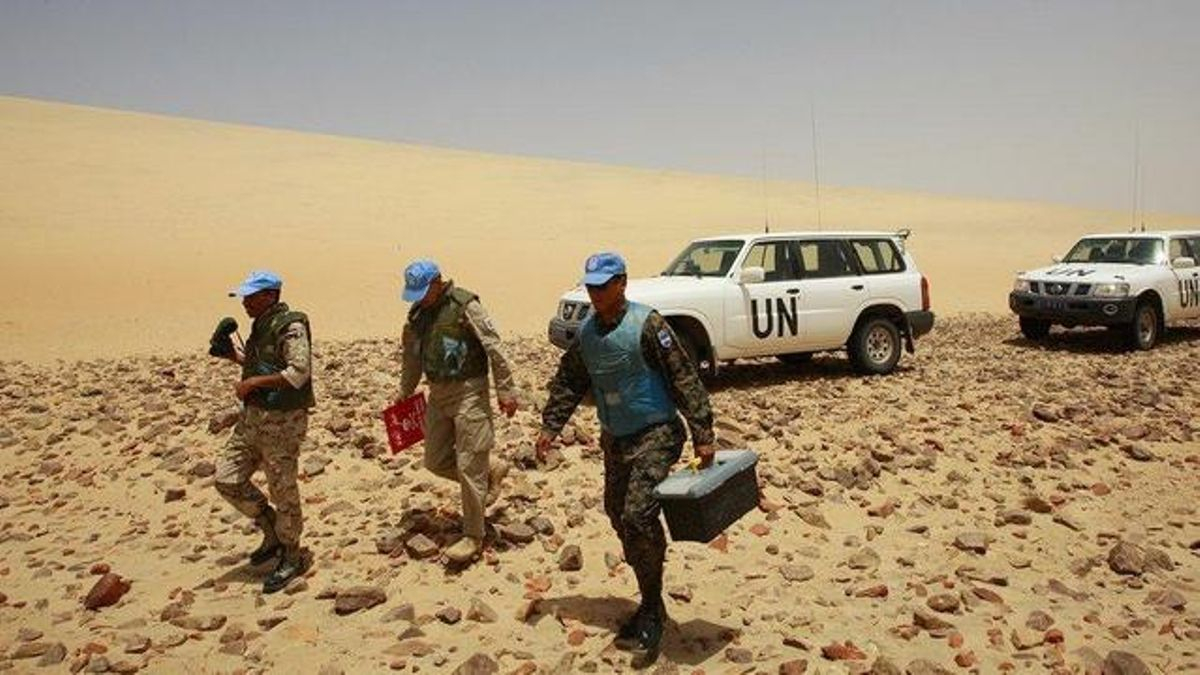
Experts disagree on who benefits from the withdrawal of the UN peacekeeping mission MINURSO in Western Sahara, but they are united in recognising a significant loser: stability. For the Canary Islands, this stability is crucial for economic and social survival.
In recent months, I have detailed the shifting geopolitical landscape affecting the Canary Islands. I’ve discussed issues ranging from the melting Arctic to new shipping routes influencing the rivalry among the US, Russia, and China. I highlighted Morocco’s strategic ports like Tangier Med, Nador, and Agadir, and their ambitions over our waters and the Tropic Mountain.
Now, I must address a critical update: On 30 October, the UN Security Council failed to renew MINURSO’s mandate, which has monitored ceasefires between Morocco and the Polisario Front since 1991. Russia vetoed a proposal from the US that had received eleven votes in favour. The draft suggested changing MINURSO to MINUSO and establishing Morocco’s autonomy plan as the only negotiation framework. The US then rejected Russia’s proposal to extend the mission with its existing terms, which only garnered three votes of support. As a result, the mandate expired at midnight on 31 October. After 35 years, the UN departs from Western Sahara without fulfilling its original mission.
The reactions from involved parties reveal much about the emerging situation. Morocco’s Royal Cabinet termed the non-renewal “a significant advance,” announcing that the mission’s personnel and equipment must leave within days. Meanwhile, Minister of Foreign Affairs Naser Burita stated Morocco would not attempt to dissuade Moscow from its veto, claiming Morocco benefited in either scenario. The Polisario Front called it a “historic day,” expressing gratitude for the Russian veto. Algeria voiced its “deep sorrow,” blaming the pro-Moroccan bias in the US text.
While some celebrate, a genuine void emerges. A high-ranking official within the mission described its role as a political “alarm cable” not just between Morocco and the Polisario, but also between Morocco and Algeria. With the mission gone, the risk of conflicts spilling over beyond Mauritania or Algeria increases, particularly given that the Polisario declared a return to conflict in 2020, which has led to a low-intensity struggle where Morocco controls around 80% of the territory.
Many, including myself, feel concern over the outlook. Rising voices from experts mostly agree on one word: uncertainty. Riccardo Fabiani from Crisis Group summarised succinctly: “Everything is uncertain, and uncertainty dominates the situation.” He warned of an immediate risk: Morocco may militarily occupy the so-called buffer zone, previously monitored by observers, escalating the situation dangerously for regional stability.
Hannah Rae Armstrong, a Maghreb and Sahel specialist, termed the US draft a “recipe for a return to conflict,” significantly raising the risk of escalation. UN Secretary-General António Guterres has raised alarms about the territory’s security, reminding that the end of the mission “does not negate” the Sahrawi people’s rights, especially their right to self-determination. Oxfam has warned that the end of oversight endangers the civilian population and thousands of refugees still in Algeria.
On the Moroccan side, some analysts argue the Russian veto does not change the course; the 2025 resolution 2797, which established Moroccan autonomy as a negotiation foundation, remains valid. The Elcano Royal Institute found a “overwhelming international trend” favouring autonomy, suggesting Morocco enjoys diplomatic momentum but has lost its field arbitrator. This combination is especially dangerous, as those feeling secure might act more aggressively.
Closer to home, professor José María Peredo cautioned that while loosening a situation is one thing, handing over unilateral decision-making to a dominant power is another. He noted that any changes in sovereignty over waters with differing delimitations will require the involvement of other stakeholders, including the Canary Islands. Any legal changes regarding the status of Western Sahara will directly impact our marine territories, resources, and airspace.
From this, I conclude that while opinions differ on who profits from MINURSO’s departure, everyone agrees: the loser is stability. Stability in the central Atlantic is vital for the Canary Islands’ economic and social survival.
What is unfolding is not merely a diplomatic failure, but the crystallisation of blocs. On one side are the US, Morocco, and Israel, who will endeavour to cement the Sahara’s annexation as a fait accompli. The US ambassador stated bluntly that “we must try something different,” underpinned by military support. Morocco already operates on a defence budget of around $15.3 billion, acquiring advanced weaponry from the US and Israel.
On the opposing side, Algeria and Russia are positioned against Morocco. Just a day before the vote, during the Russia-Africa Summit, President Tebboune expressed gratitude to Moscow for its “constant support” for Sahrawi self-determination. The veto came the next day. Russia, expanding its influence in the Sahel and West Africa, sees Western Sahara as a stage to challenge the US, not far from Europe. Algeria, having severed ties with Morocco since 2021, will resist any annexation, creating a new frontline of confrontation in our immediate vicinity.
China abstained on the US resolution but voted for the Russian one, playing a different game focused on economic interests: ports, infrastructure, and access to resources. They seek to avoid an open conflict that would disrupt shipping routes while also looking to benefit from the chaos.
At the heart of this situation lies a battle for control over parts of Africa, the central Atlantic, the Strait of Gibraltar, and the Mediterranean. The conflict adjacent to the Canary Islands is not isolated; it is part of a larger reconfiguration of alliances where Morocco stands to gain and the Canary Islands face exposure.
Some may think that the withdrawal of a few observers in the desert is of little consequence to daily life; they are mistaken. Every concern I’ve outlined in recent months intensifies without MINURSO.
I first highlight Dakhla, a port being developed in an occupied territory with an investment of around 1.3 billion euros. It aims to capture transhipment traffic and logistics services redirected from the Port of La Luz in Las Palmas. Without UN oversight, Morocco will expedite these investments and aim to legitimise them with European businesses and institutions, including those in the Canaries. As I stated in January, bolstering Dakhla undermines international law and undermines our port. The Spanish government cannot claim ignorance; it must take a firm stance against both violations of International Law and Human Rights.
Next are our waters. In 2020, Morocco enacted maritime delimitation laws that included Sahrawi waters and seeks to extend its continental shelf to 350 miles, encroaching on the Tropic Mountain near El Hierro with its rich mineral resources. If Morocco removes Western Sahara from the decolonisation agenda, it will likely claim these waters without legal hindrance. Any delimitation dispute with the Canaries would shift from being a discussion between a state and a non-self-governing territory to a negotiation between equals. This is unacceptable.
I turn to airspace as well. The flight information region covering Western Sahara is managed from Gran Canaria. Morocco has long demanded control and MINURSO’s exit provides it with fresh arguments to claim what it sees as a sovereign right. Giving up this control would be a significant mistake, weakening our situational awareness and security over a region that could see military tensions in the near future.
Migration is another critical issue. We’ve seen it in Ceuta; when it suits them, Morocco relaxes border controls as a show of strength. An unstable Sahara, with troop movements and a deteriorating Sahel, is a perfect breeding ground for increased pressure along the Atlantic route. It’s local councils, municipalities, and the Autonomous Community that will face these challenges head-on.
Finally, I revisit the port situation. The operation involving Marsa Maroc’s acquisition of 45% of Boluda Maritime Terminals, pending approval, assumes increased importance in this context. Should we allow a public company from a state that has effectively terminated the UN process in Western Sahara to participate in our port decision-making? Prior concerns over this acquisition have only intensified.
There’s a notable paradox here. The crises in the Strait of Hormuz and insecurity in the Red Sea are directing shipping towards the Cape of Good Hope. Historically, such shifts could benefit La Luz, as seen during the Suez Canal closures in 1956 and 1967. But this opportunity exists only if the central Atlantic is viewed as stable. An open conflict in Western Sahara could inflate shipping costs, alter routes, and transform our strategic oceanic position into a liability. Our location is an asset only if we can protect it.
The shift in 2022 when Pedro Sánchez aligned Spain’s position with Morocco over Western Sahara seeking stability hasn’t delivered the promised results. Rather, it reinforced perceptions that Spain yields under pressure. A partner that sees success through pressure will continue exerting it, as evidenced by events in Ceuta. The recent approval of citizenship rights for Sahrawis in Congress shows that Spanish society remembers its historical obligations.
Therefore, I outline clearly what must be done. Spain and Europe should advocate at the United Nations for monitoring mechanisms to prevent the void left by MINURSO from being filled with arms and to uphold the issue of Western Sahara on the decolonisation agenda. The EU must shift focus from the east and develop a central Atlantic strategy incorporating the Canaries. The state must legally fortify our waters, the Tropic Mountain, and air traffic management from Gando, with no compromises made without Canary representation. The entry of Marsa Maroc into Boluda should be halted. Marine, aerial surveillance, and protection for our critical infrastructure, including ports and energy systems, must be reinforced. We should invest in offshore wind energy and renewables, as energy independence is also a matter of security.
Stating all this is not an act of hostility towards Morocco or its people, with whom the Canaries have valued historic and commercial ties. Cooperation is essential, dependency is not. However, a mature neighbourhood cannot be built on one side’s calculated ambiguity or the perpetual concession of the other.
When monitors withdraw, imposers take charge. This is a lesson we must not learn through painful experience. Morocco will play the cards we allow it, while the US, Israel, Russia, and China will do likewise. It is up to us, Spain, and Europe to ensure the Canaries are not the chessboard upon which others play their game. Defending our position in the Atlantic is not an ideological matter; it is an institutional obligation, and as President of the Gran Canaria Cabildo, I will not neglect it. Yet, I am concerned that many of our political and institutional interlocutors remain silent in the face of our current circumstances.


