



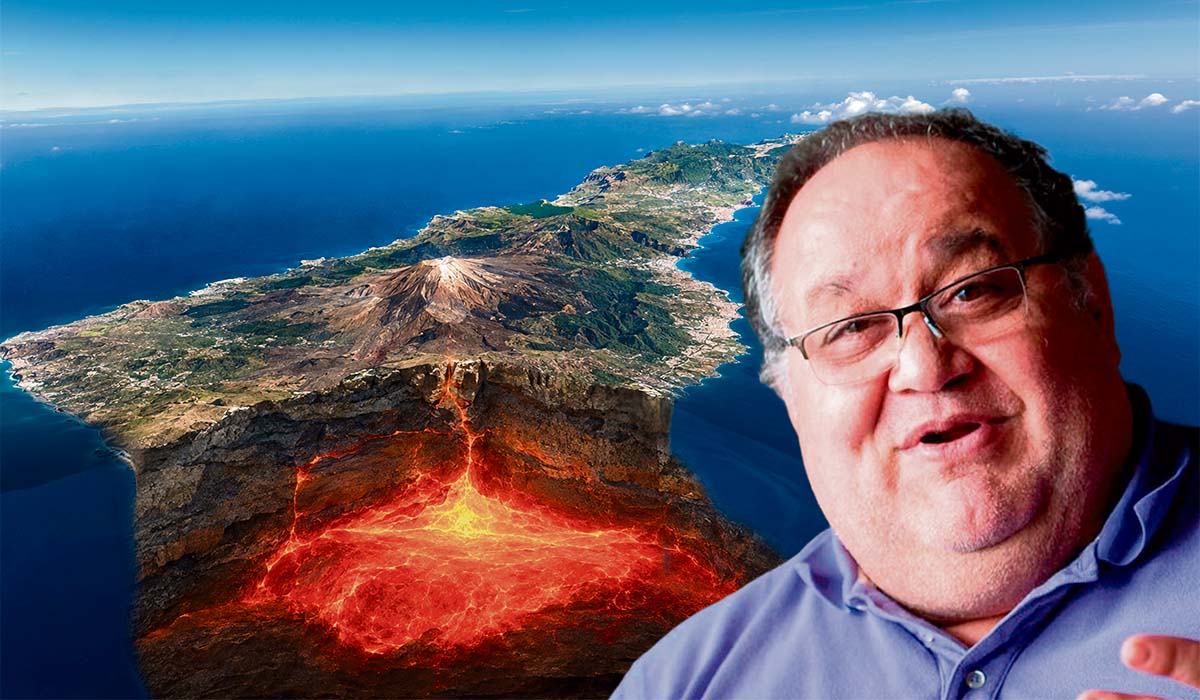
The Volcanological Institute of the Canary Islands (Involcan) recently released a detailed 3D image of the volcanic structures beneath Tenerife, revealing a significant amount of magma in a complex network resembling neural connections. The institute’s scientific coordinator, Nemesio Pérez, assured that while this discovery is important, “the probability of an eruption remains low.”
Pérez clarified that the identification of magma accumulation under an active volcano is not surprising. However, the study provides a much clearer picture of the deeper volcanic structure, highlighting several low-s seismic anomalies located between 10 and 30 kilometres deep, which may indicate areas of partially molten material. The most notable of these anomalies is situated in the north-west region of the island.
He emphasised the need to distinguish between volcanic activity and eruption probability. “There’s no scientific evidence suggesting an imminent eruption in Tenerife,” Pérez noted, as confirmed by both the Scientific Committee of Pevolca and Involcan. However, he acknowledged that Tenerife is volcanically active and has witnessed unusual activity since 2016, justifying enhanced monitoring.
The study’s findings do not alter the short, medium, or long-term eruption probabilities, which remain low. Yet, it has improved understanding of the deep magmatic system and highlighted an active volcanic-hydrothermal process linked to seismic activity and geochemical changes. “Demonstrating the existence of an active magmatic system is one thing, showing that it’s evolving toward an eruption is another,” Pérez explained.
For an eruption to be imminent, a consistent set of signals would need to be observed, such as seismic activity migrating to shallower levels, a sustained increase in certain gases, or significant changes in ground deformation. So far, these indicators have not appeared.
When queried about which island has the highest eruption risk, Pérez took a cautious stance. “We cannot scientifically claim that the next eruption will occur in La Palma, Tenerife, or elsewhere. The Canary Islands remain volcanically active, and future eruptions are inevitable. While historical data provides some insights into the activity level of each island, there’s no scientific basis for definitively ranking them by eruption likelihood.”
Pérez highlighted that the primary area of seismic anomalies lies below where most seismic activity has occurred since 2016. In 2026 alone, several significant episodes were recorded, likely linked to the injection of magmatic fluids into the crust, causing pressure changes deep below the surface. However, this does not mean that magma is rising to the surface.
On La Palma, studies conducted by Involcan in 2024 found a larger anomaly beneath Cumbre Vieja compared to Tenerife. Research confirmed that these anomalies are associated with the two magma chambers that fueled the 2021 eruption. This ongoing research aims to enhance the understanding and monitoring of the volcanic systems across the Canary Islands, including El Hierro, Gran Canaria, and Lanzarote.