


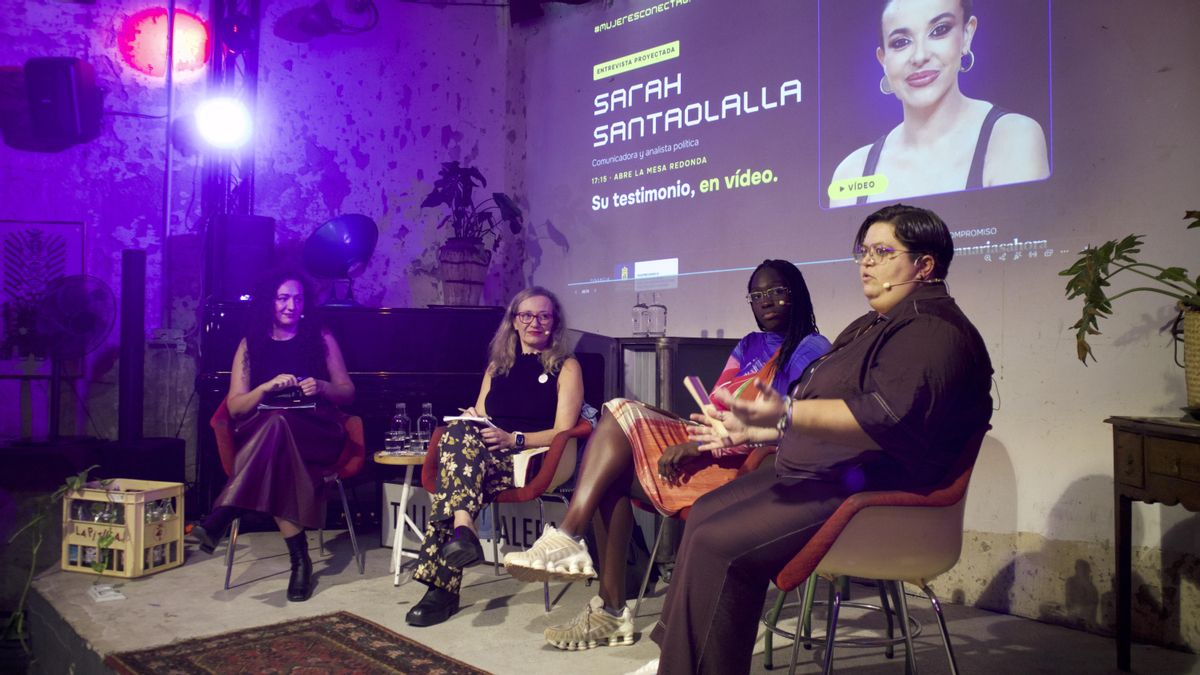
Sarah Santaolalla opened a round table discussion focused on the impact of digital violence against women and the importance of involving institutions, social platforms, and society as a whole. The event, titled ‘Sin Filtros’, was part of the fourth edition of #MujeresConectadas: Strategies Against Cybermachismo, held this Tuesday at Talleres Palermo in Las Palmas de Gran Canaria.
Jennifer Jiménez, a journalist from Canarias Ahora who specializes in equality and gender-based violence, moderated the session. She shared statistics highlighting the prevalence of digital harassment; nearly 80% of young people aged 16 to 24 have experienced some form of online abuse, and 73% of female journalists worldwide have faced online violence, according to a UNESCO survey. Jiménez noted that these attacks often intensify when combined with other forms of discrimination, such as racism and LGBTQ+ discrimination.
Before inviting other speakers, Jiménez presented a pre-recorded testimony from Santaolalla. She discussed how attacks against her have extended beyond her political views to include her appearance, clothing, and personal life. Santaolalla pointed out that while not all women face violence equally, those who publicly express leftist, feminist, or anti-fascist views often encounter particularly harsh harassment.
Santaolalla detailed the progression of her experiences with harassment, which began with feelings of guilt, evolved into anger, and eventually led to her normalising the abuse as part of daily life. She described how online threats had escalated into physical assaults, with insults and violent confrontations altering her routines and forcing changes in her public behaviour.
“When the digital part requires you to seek help to keep living, you start seeing danger up close,” she explained. Santaolalla mentioned that she felt the need to sleep with her phone turned off and bought an alarm clock to reduce her dependence on it. She highlighted the alarming lack of fear among harassers, who sometimes make threats using their own accounts with personal details visible.
Her testimony prompted discussions about the toll on women who choose to take up public spaces. Victoria Rosell, a judge specialising in violence against women and former delegate against gender violence, recounted her own experiences of being attacked during her time in Congress, stressing that these aggressive reactions are not coincidental. She pointed out that feminism represents a powerful force for democracy, thus becoming a target for those opposed to its progress.
Rosell expressed concern about the hostile climate’s impact on young women considering a political career or seeking visibility in public life, noting that fear of attack can deter them from engaging in these arenas.
Ngone Ndiaye, a journalist and researcher at the Fundación porCausa, discussed how the intersection of racism and misogyny compounds the attacks faced by women of colour. She shared examples of the hostile reactions towards migrant women sharing their personal stories, including calls for them to “leave the country” if they express an opinion. Ndiaye voiced her own concerns about hostility directed at her work and questioned if such backlash was a sign of what awaited her career.
Both Santaolalla and Ndiaye agreed that digital violence transcends the screen. Ndiaye challenged the role of social media platforms, particularly after witnessing severe comments posted by verified accounts.
The conversation also addressed the influence of organised groups that use social networks to spread anti-feminist rhetoric and translate social discontent into hostility toward women. Nereida Vizuete, a social educator and co-founder of Marviz Consultoría, echoed these worries, highlighting how algorithms can amplify such harmful messages. She suggested that engaging with feminist content on social media could be a means of reclaiming space, while also recognising the importance of knowing when to engage or step back from provocations.
Vizuete observed a growing sense of impunity around expressing misogynistic and racist views, but she remained optimistic, noting that young people today are not necessarily worse than previous generations. She mentioned encountering significant resistance from young women who challenge their peers’ sexist attitudes.
Education emerged as a crucial tool for combating cyber misogyny. The participants emphasised the need for classroom initiatives that involve young men and provide training for those tasked with addressing these issues, including law enforcement and judicial professionals.
From a legal standpoint, Rosell acknowledged ongoing challenges in adequately responding to digital assaults. She noted recent regulatory advancements allowing the removal of harmful content prior to a final ruling, but emphasised the need for further research and diligence in many cases. She proposed establishing secure digital repositories managed by the state, where victims could store evidence of attacks for investigation, similar to the approach for other forms of violence.
Throughout the discussion, criticisms of institutional responses and platform operations were prevalent. Ndiaye raised concerns that victims often face repercussions when they report abuse, sharing instances where individuals had their accounts restricted for posting evidence of their harassment.
The session concluded with a shared commitment to support women experiencing these aggressions. Santaolalla underscored the necessity of a supportive network of women in helping her cope with psychological fatigue. This sentiment resonated with the participants’ proposals to create safe spaces, provide mutual support, and foster communities where women can express themselves without fear.


