


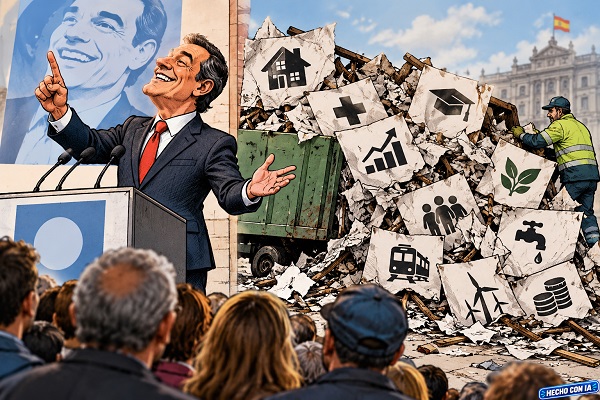
Citizens should consider a crucial question whenever a politician announces policies aimed at transforming their lives: Is the promise genuinely achievable, or is it merely an electoral tactic designed to win votes? The distinction is significant. When rooted in feasible political commitments, it reflects the realities of governance; when simply a strategy, it exploits voter hopes to gain power.
A recent example is New York Mayor Zohran Mamdani, who took office in January. His campaign promised free buses, municipal supermarkets to curb food prices, a $1 billion annual community safety office, and an ambitious expansion of public services. These commitments were expected to visibly transform daily life for millions of New Yorkers. However, political and financial realities have led to many of these proposals being revised or stalled.
On October 19, journalist Jonathan Chait highlighted that the much-anticipated free buses were absent from Mamdani’s initial transportation plan. Though Mamdani claims he still intends to implement them, the community safety budget has shrunk to just over $40 million annually, far from the original promise. Similarly, the plan for public supermarkets has been scaled back to a pilot project, and universal childcare for two-year-olds has commenced only gradually rather than immediately as pledged.
Mamdani has, however, committed to freezing rents for stabilised housing and has accelerated private housing permits. He has also retained Police Chief Jessica Tisch and resisted efforts to surrender municipal control of schools. These elements show that while there are efforts being made, they have often fallen short of initial promises. The challenge remains whether the significant gap between campaign ambitions and governance realities reflects realistic governance adjustments or simply unfulfilled electoral promises.
This situation in New York raises broader questions beyond ideological divides. Electoral campaigns have turned into showcases where candidates strive to provide quick fixes to complex problems, such as free transport, affordable housing, and improved public services. Proposals are framed as straightforward political decisions, yet their execution often relies on budgets, parliamentary majorities, administrative powers, and economic conditions that persist post-election.
In Spain, Prime Minister Pedro Sánchez offers a more extensive case study on the relationship between promises and outcomes, with media records highlighting discrepancies. His comments while in opposition, commitments upon entering La Moncloa, and subsequent agreements with various political factions reveal a pattern.
In April 2015, for instance, Sánchez stated unequivocally on Navarra Television that there would be no agreements with the Basque separatist party Bildu, a position he reiterated multiple times. However, by November 2020, Bildu supported the state budget, a shift that contradicted earlier pledges. This example illustrates the dilemma when political leaders alter their stance on previously declared red lines without satisfactorily explaining why what was once unacceptable is now deemed necessary.
A similar contradiction arose with Sánchez’s stance on pardons for Catalan separatist leaders during his 2019 election campaign. He had insisted that they must serve their full sentences, yet in June 2021, his government granted partial pardons, creating an evident contrast with his previous rhetoric.
Other democratic regeneration promises have also failed to materialise. In 2018, Sánchez vowed to reform the constitution to eliminate parliamentary immunity, aiming for quick approval, but the proposal lapsed without further progress. Similarly, he had pledged in 2014 to close ‘revolving doors’ between high-level public officials and private enterprises, a commitment that has not yet resulted in tangible legislation.
The current legislative session reveals further unfulfilled commitments. Although Sánchez’s PSOE pledged to reduce the working week to 37.5 hours without salary cuts, this measure was rejected in Congress. By July 2026, a review by Newtral counted five unfulfilled obligations among fifty commitments, highlighting substantial gaps between promises and reality.
The housing sector has also entered the spotlight as Sánchez announced new measures in early October, which are still pending parliamentary approval. This has raised concerns with the Central Electoral Board regarding possible violations of the duty of neutrality during the electoral period, adding scrutiny to governmental announcements that resemble campaign tactics.
As elections approach, parties are unveiling new aid, reforms, and rights while citizens seek to discern which proposals will result in concrete decisions. The risk is that electoral campaigns devolve into a series of increasingly ambitious commitments made without clarity on their funding, required majorities, or necessary sacrifices.
Not all unfulfilled promises are alike. Unexpected economic crises or parliamentary defeats can hinder a government’s capacity to deliver. While modifying alliances is legitimate in a parliamentary democracy, failing to explain discrepancies after previously clear commitments risks eroding trust.
In summary, both Mamdani and Sánchez illustrate the tension between electoral ambition and the limits of power. The New York mayor is learning that governance often requires compromises on campaign promises, while Sánchez’s record of unfulfilled pledges warrants scrutiny ahead of the upcoming elections.
Ultimately, voters bear the responsibility but are entitled to demand explanations, compare commitments with outcomes, and distinguish between those who acknowledge challenges and those who exploit them as excuses.
A democracy should not hold candidates to an inflexible standard of fulfilling every promise regardless of context. However, it should expect transparency about what was promised, what was accomplished, and why discrepancies arose. The ballot is not a blank cheque; it is a vote of confidence that should be based on tangible results, not just persuasive rhetoric.
The lingering question remains: How many times can a leader ask citizens to trust their promises without accountability for promises made before? The answer should hinge on voters’ memories, not a politician’s election-winning skill.


