

Generations of women from La Graciosa once voyaged across the sea and traversed the steep cliffs of Risco to trade fish for food. This very route also served to transport the deceased to Haría before the island had its own cemetery.
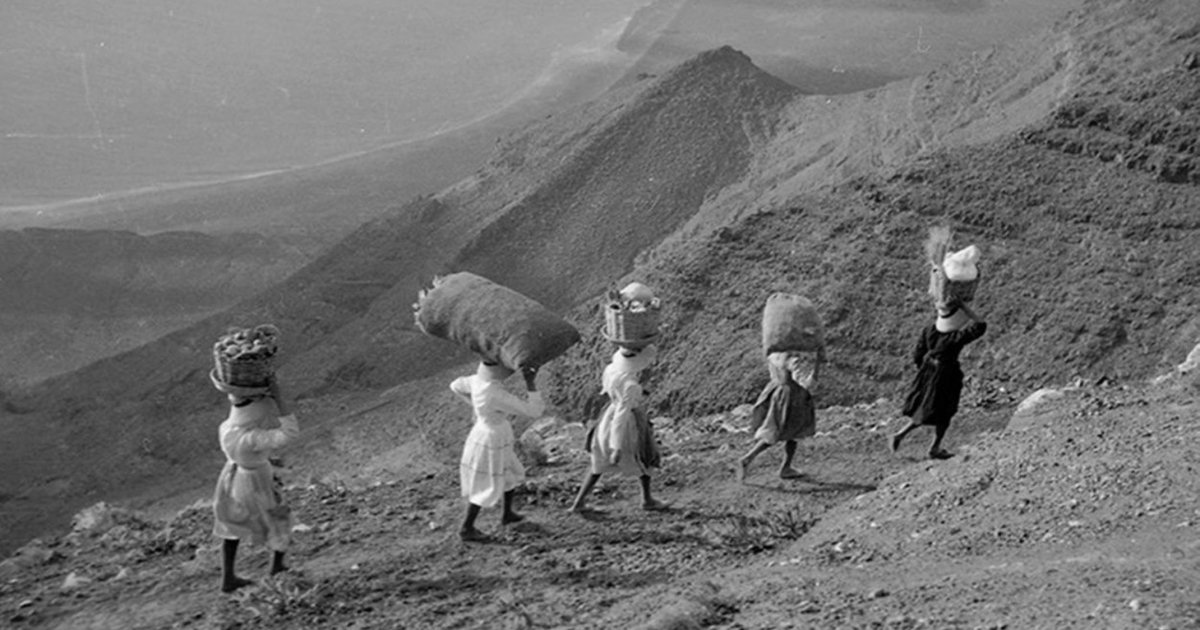
The legacy of the Camino de los Gracioseros showcases a significant aspect of life in La Graciosa: these women braved the sea to reach the Famara coast, ascending the Risco in hopes of returning with essential supplies for their families. Their traditional hats, baskets, and the loads they carried are preserved in historical photographs and anthropological studies, as well as in stories passed down through generations.
Beyond the imagery, the journey played a vital role in the local economy. It wasn’t simply a leisurely outing; it was essential for a community reliant on fishing for survival and on Lanzarote to procure much of what they couldn’t cultivate themselves.
On 14 October 2023, the second Bajada del Camino de las Gracioseras publicly commemorated this memory, honouring the women who transformed the path into a crucial supply route. The event also highlighted a less known aspect: the same path used to bring fish to northern Lanzarote was also taken by funeral processions in much more painful circumstances.
Historically, the Camino predates its commercial significance, originally linked to land use, grazing, and communication between the Famara coast and northern Lanzarote settlements. As the La Graciosa community developed, this route became an everyday part of life. Fishing remained vital, but local produce like vegetables, potatoes, grains, and textiles had to be imported from Lanzarote through trade or purchase.
This journey encompassed three inseparable elements: the sea, the landing coast, and the path up the Risco towards Yé and the villages of Haría. Reaching dry land didn’t mark the journey’s end, as further travel through rural areas was needed for trading the fish.
Research highlights the significance of this activity in the decades prior to regular transport services, although it doesn’t pinpoint an exact start date for the commercial use of the trail. Its history reflects a continuous adaptation dictated by the needs of those who relied on it.
Women played a crucial role in this economic cycle; while men primarily fished, women managed the preservation, marketing, and transport of the catch. At a time when boats lacked engines, women carried fish to Lanzarote, climbed the Risco, and returned with necessities.
Anthropological studies by Manuel del Río Suárez detail this economic structure and the exchanges made with places like Haría, Teguise, and Arrecife. Fish could be sold or swapped for produce and other goods, making women’s contributions essential to family sustenance.
Traditional accounts describe heavy burdens and women who often walked barefoot on certain stretches to spare their espadrilles. These narratives illustrate the journey’s challenges, although conditions varied for different women at different times.
The Risco thus became an economic infrastructure, worked out of necessity and physical endurance. On one side was the fish; on the other were the foods and goods essential for households.
A notable aspect of this tradition was the signalling system that helped inform families of the women’s return. Once at the top of the Risco, they would light bonfires to signal they were back. These signals would often be reinforced at stone enclosures known as tegalas along the shore, which allowed families to identify which boat to expect.
This signalling system had a practical role in a community separated from Lanzarote by the narrow El Río, coordinating the final leg of the return and confirming the end of their journey.
The tegalas also emphasised that the path extending upwards wasn’t the journey’s conclusion. Its function relied on a family network waiting at the coast, recognising the signals, and facilitating a safe return. Thus, survival depended not only on individual efforts but also on community organisation tailored to the local environment.
A particularly poignant element of Camino history involved funeral rites. Before La Graciosa had its own cemetery, the deceased were transported to Lanzarote for burial. Del Río Suárez’s research shows that bodies were taken by boat to the coast, where a funeral procession then ascended the Risco to Haría. The same pathway that women travelled for trade turned into a funeral route in times of grief.
The absence of a local cemetery forced families to navigate the sea and the steep climb under heartbreaking circumstances. This path connected markets and homes, linking the living with the resting places of their loved ones.
This began to change in the 1940s when the Canary Islands’ Economic Command initiated the construction of basic infrastructure on La Graciosa. Photographic documentation reveals that 12,000 pesetas were allocated for the cemetery in 1943. Subsequent projects included the church, pier, and a cistern.
These developments were part of a transformative process that provided the island with long-overdue services. The cemetery was more than just a burial site; it ended the need for families to repeatedly ferry their deceased to Haría for interment.
As maritime and land transport evolved, the path’s regular commercial role diminished. However, its importance adjusted gradually. In 1987, Jesús Manuel Páez recalled in Lancelot the challenges of boat crossings and the path’s continued relevance in bad weather.
The legacy of this route persists in photographs, research, and oral histories. The commemorative Bajada served to revive this tradition and acknowledge the efforts of those who sustained the island’s economy, without aiming to recreate a past way of life.
This path tells a broader story of women who played a crucial role in family economies, a community adept at utilising available resources, and essential ties with Lanzarote for daily living. Although the Risco de Famara presented a physical challenge, it never fully separated La Graciosa from Lanzarote. For generations, the islanders found ways to bridge the sea, traverse the land, and honour their dead.
The Bajada on 14 October 2023 was a reminder of a tradition that predates it, celebrating the silent toil of countless generations, particularly women whose contributions were vital for their families’ survival. Once, life in La Graciosa relied on a crossing, a climb, and a signal fire—upon which an entire community depended.