


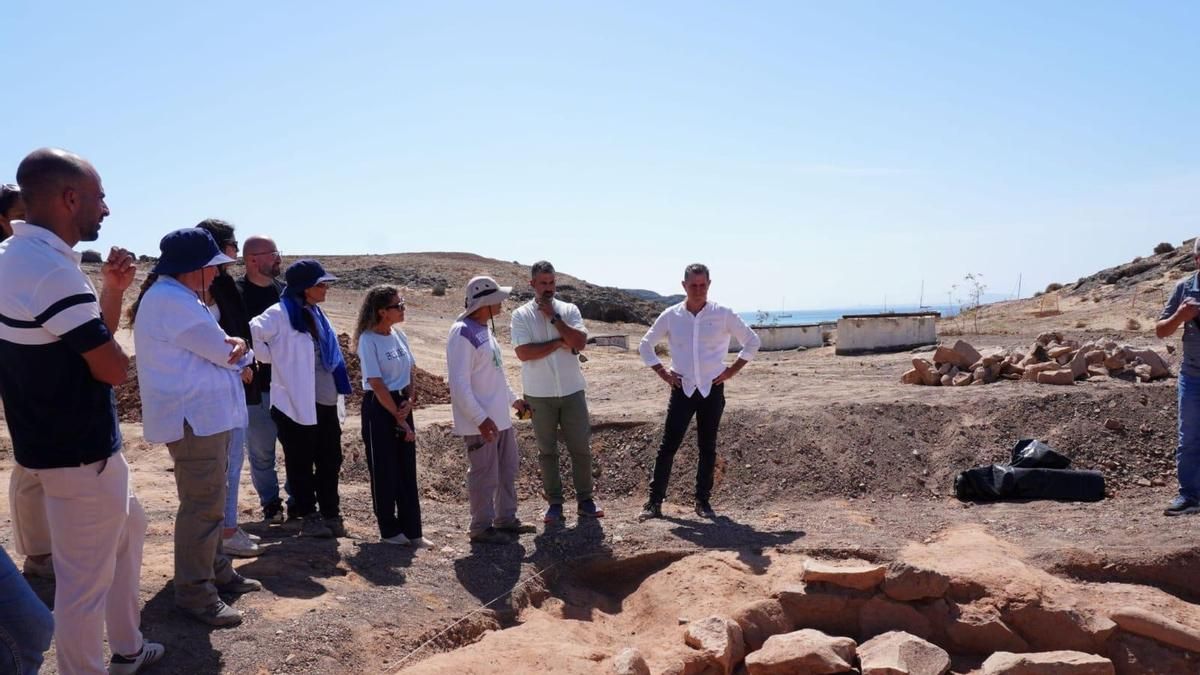
The seventh excavation campaign at the San Marcial de Rubicón site in southern Lanzarote has concluded, uncovering two new wells, a lime store, and an area with compacted earthen flooring. Esther Chávez, co-director of the archaeological project alongside the beaches of Papagayo, stated that the research is a collaboration between the Universities of Las Palmas and La Laguna, funded by the Canary Islands’ Directorate General for Culture and Cultural Heritage.
According to Chávez, this month’s work focused on the Barranco de Los Pozos, aiming to find hydraulic structures based on oral histories and documents that suggest more wells exist in the area. She explained that “two new wells and a third structure related to water usage” have been discovered.
Additionally, by expanding the area of exploration, researchers found a lime store linked to one of the island’s first lime kilns, excavated in previous campaigns. This provides further insight into the daily life of the settlement.
A third area investigated seems to represent a plaza that potentially led to a church, where geological cuts in the basalt level and compacted earthen pavements were found, indicating how the space was used.
The excavation was visited by Miguel Ángel Clavijo, the Director General of Culture and Cultural Heritage, and Silvia Santana, the heritage councillor for Yaiza. They joined co-directors of the research to discuss the latest findings of the ‘Proyecto Rubicón’.
Clavijo highlighted the historical significance of San Marcial de Rubicón, noting its written records and the ongoing excavations, which allow for a rigorous understanding of the historical accounts. He remarked, “This helps us discover and comprehend the spaces these communities occupied to live and thrive in a particularly challenging environment marked by water scarcity.”
The coastal area of Rubicón was where the Norman Jean de Bethencourt anchored his ships in 1402, founding the first European settlement in the Canary Islands. Two years later, a papal bull from Benedict XIII declared San Marcial de Rubicón a city and established the first cathedral in the archipelago, as reported in recent journalistic research.
Since the current scientific team began their work in 2019 through a partnership between the two public universities, the Directorate General for Cultural Heritage, and the Yaiza Town Council, they have drawn a clear conclusion: “Excavations unequivocally indicate that San Marcial was occupied only once, in the 15th century. It was neither occupied before nor after.” This was stated by Miguel Ángel Hervás, a specialist in medieval archaeology.


