


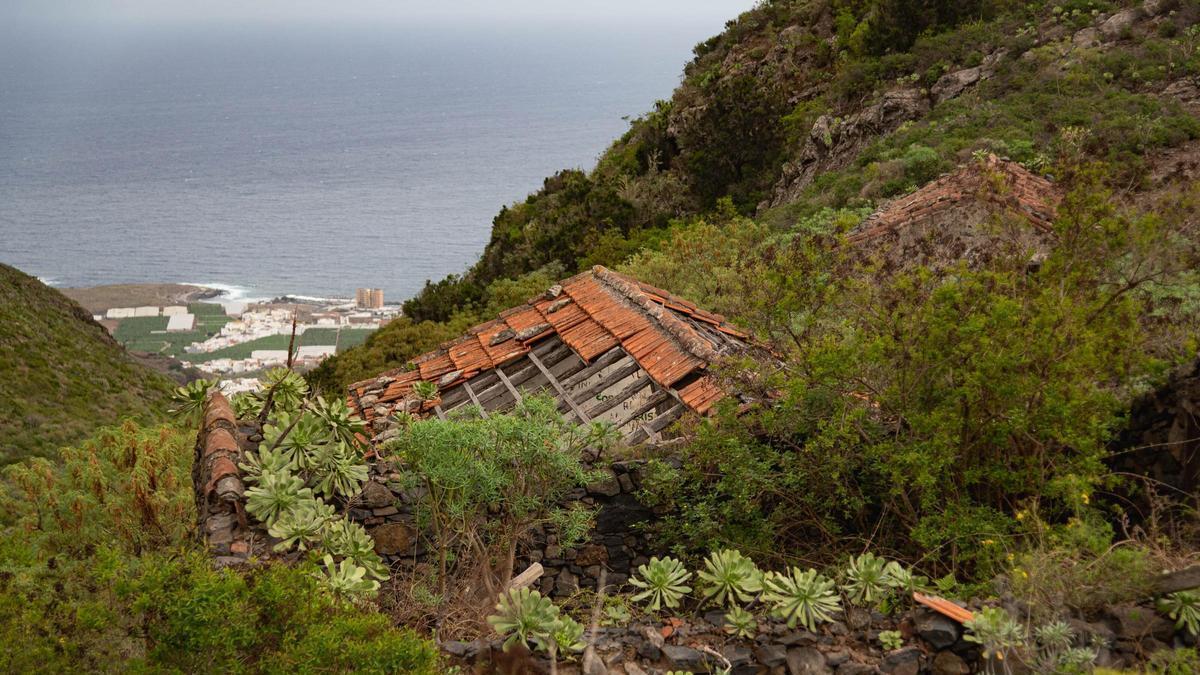
No one has lived in Las Moradas for decades. This abandoned settlement, nestled in the hills of Los Silos, has been largely forgotten, with no reliable testimony to its past. A cluster of four homes form the lower part of the settlement, while two more sit atop the hill, overshadowed by the striking Roque de Las Moradas.
The once-bustling area is now silent, save for the chirping birds and the rustle of wildlife. The nearby Bucarón ravine winds its way down to the coast, flanked by lush banana plantations.
Biologist Vicente-Lope Lucía Sauquillo has published works for the Canary Islands government under the title ‘Didactic Routes.’ One chapter focuses on a trail that passes through Las Moradas, shedding light on its residential and ethnographic history. Lucía reveals there were once extensive orchards here, abandoned since the mid-20th century. He recounts that the homes of Las Moradas were used until the agricultural activity ceased. In the 1970s, a shepherd named Pepe moved in with his mother and sheep, dwelling in the best-preserved house until his mother’s death led to the settlement’s abandonment.
Archives from Los Silos document agricultural and livestock activities, noting a brick kiln in the 20th century and a reliance on charcoal for survival before electricity. Historical sources confirm agricultural development, with evidence of a threshing floor existing in the 1960s.
The name Las Moradas suggests a place of refuge, and despite their dilapidation, the houses still hold remnants of home. The lower settlement overlooks the deep Los Cochinos ravine, its walls covered in greenery. Municipal information hints at an indigenous residential link to the area. Sauquillo’s educational material suggests the location once harboured significant activity, as a burial cave with human remains and clay necklaces was discovered nearby, indicating the area may have served as a Guanche settlement for pastoralism.
Though modest, the houses are more than mere storage sheds; they are almost in ruins, lacking roofs, doors, and windows, yet some still have locks and chains rusting in time—symbols of past guardianship. The structure primarily uses stone, wood, and tile, with roofs combining traditional Arabic and newer French tiles, indicating a blend of construction styles.
Daura Elías González has also explored the vacant Las Moradas in her master’s thesis, highlighting the site as a notable example of architectural survival and adaptation in rural settings. She emphasises that while it may seem like simple rural architecture, it reflects a unique adaptation to the environment.
Las Moradas remains a collection of deserted homes that intrigue hikers while evoking visions of goat herding, cereal farming, or ancient indigenous routines at the brink of the precipice. There are calls for recognition and protection of such sites against vandalism and neglect. The researcher didn’t identify any protective status in her recent study, raising questions about the need for preservation efforts to highlight the history of life in this seemingly inhospitable location.


