


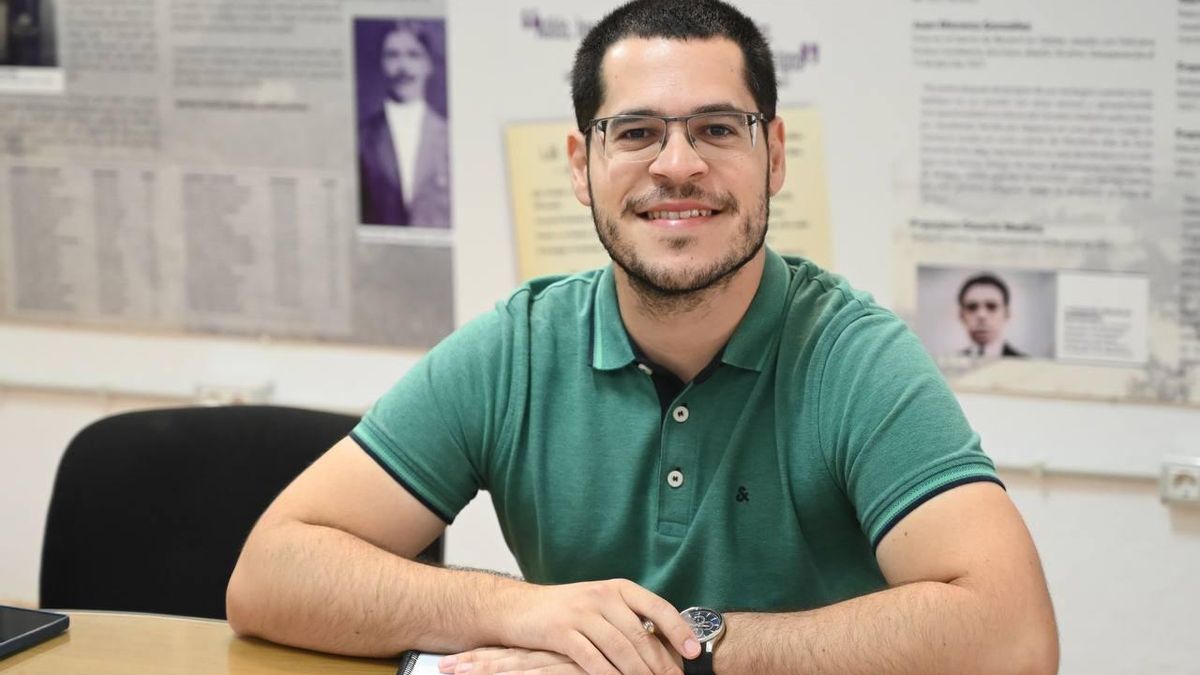
Call for Historical Memory Education in Arucas
Eduardo Hernández, a member of the Arucas Historical Memory Association, argues that it is not enough to simply acknowledge victims of the Franco regime or recover their remains; it is crucial to clarify what happened and uphold their rights. His sentiments come after the successful screening of “Canarias: 50 Years After Darkness” in Arucas, which received a warm reception.
Having studied law at ULPGC and a Master’s in Human Rights and Globalisation at UOC, Hernández was awarded an honorary mention for his thesis on humanitarian law and neurotechnology. He collaborates with the Arucas Historical Memory Association and believes the recent Democratic Memory Law of 2022 marks a significant advancement by establishing specific obligations for public authorities, rather than just recognising rights. However, he expresses concern over some political parties wishing to replace this law with one focused on conciliation, stating, “We cannot speak of harmony while over 100,000 people remain missing, many buried in mass graves, without their families able to recover their remains.”
Hernández stresses the necessity of uncovering the truth and guaranteeing rights for victims of Franco’s repression, particularly in Arucas, where many remain unaware of the historic injustices. He recalls that on 24 March 2019, he was able to finally give a dignified burial to his great-grandparents, Juan Torres Montesdeoca and Miguel Sánchez Santana, whose remains were found in the Tenoya well. He emphasizes that “it’s a right I will always defend for all families.”
In discussing the upcoming elections, Hernández addresses the critical need for democratic memory in schools. He argues that the public must respect human rights, particularly regarding minors, stating, “Before being a migrant, a child is a child, and their rights must be protected.”
Hernández defends historical memory laws as vital commitments from democratic institutions to victims and their families. He contrasts the 2007 Historical Memory Law, which was rather timid, with the more robust 2022 law that mandates specific state actions to locate those lost during the Civil War and dictatorship, thus relieving the burden from families and advocacy groups.
He warns against the alternative proposals from certain right-wing parties, stating that a law of concord cannot substitute for the comprehensive efforts needed to address unresolved issues. “True concord must be built on truth, justice, and reparations, never on silence or forgetfulness.”
On transitional justice, Hernández explains it involves mechanisms to help societies confront their pasts marked by human rights abuses, insisting that victims and their families deserve not only recognition but justice and reparations.
He expresses concern that insufficient funding for memory policies, as seen during Rajoy’s government, strips laws of their effectiveness. “A law without resources is just paper,” he states.
Hernández highlights the lack of awareness in youth about Francoist repression in the Canary Islands, attributing some misconceptions to social media idealising the past. He believes more educational engagement is needed, pointing out that over 1,500 students visit the AMHA annually, reflecting on the importance of integrating this history into the educational curriculum.
As he reflects on the impending elections, Hernández underscores the significance of exercising the right to vote with responsibility, highlighting that voting shapes the future of rights and freedoms. The election, he says, offers a chance for citizens to influence the political landscape and underscores the need for a well-informed populace to foster a healthy democracy.
He notes the troubling rise of misinformation and discrediting tactics in political discourse, which threaten the democratic process. In addressing migration issues, he stresses that states must adhere to international law while exercising their rights to border control. Ultimately, he calls for a collective responsibility to defend the rights of all, particularly vulnerable groups like children.


