


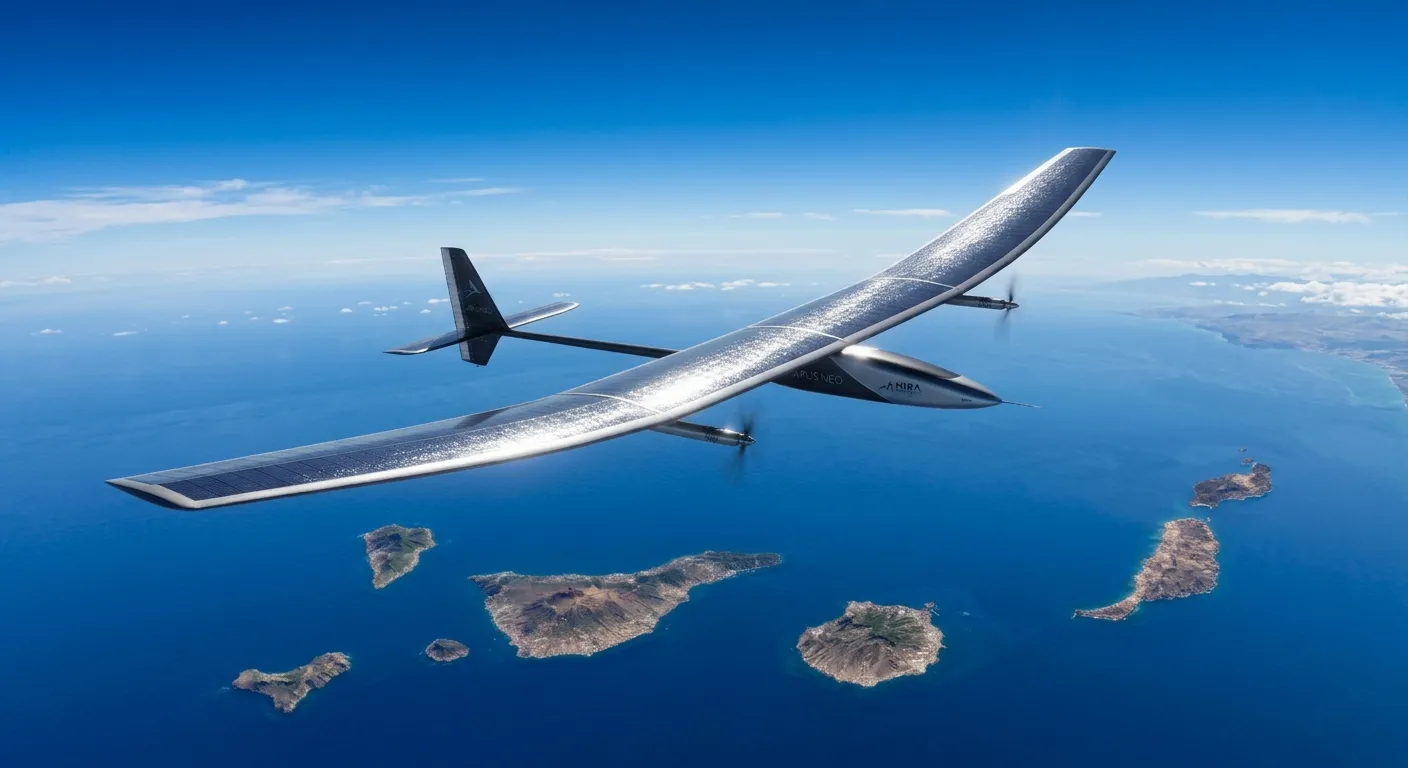
APUS NEO Returns to Fuerteventura after Over Four Days aloft
The APUS NEO, an unmanned aerial vehicle developed by Mira Aerospace, will return to the Fuerteventura Technology Park on Saturday after completing a five-day flight at approximately 30,000 feet (9,100 meters). This flight marked a significant step for Spain’s aviation sector, bridging the gap between conventional drones and satellites.
Launched from the Canarias Stratoport, the APUS NEO 18 is part of a pioneering test of a “pseudosatellite” that can fly for over 100 hours, providing capabilities not offered by traditional aircraft or satellites. Unlike satellites that orbit the Earth, this technology, known as High Altitude Platform System (HAPS), is designed to remain airborne for extended periods, conducting tasks such as observation and environmental monitoring.
The operation involves coordination among several agencies, including CATEC, AESA, ENAIRE, the General Directorate of Civil Aviation, and the Spanish Air Force. Such extensive flights require careful management within busy airspace used by commercial flights.
Mira Aerospace, a subsidiary of Space42, created the APUS NEO to enhance Earth observation and connectivity services. The aircraft weighs around 45 kilograms and spans about 12 meters in length, constructed for long-duration solar-powered flights. Although it can theoretically reach altitudes of 18,000 meters, its most recent mission maxed out at 9,100 meters.
This technology is being tested under Project ISSEC, part of the Canary Islands’ 2030 Geo Innovation Program, with practical applications in emergency management, fire monitoring, and environmental surveillance. Unlike satellites that have fixed orbits, the APUS NEO can focus on specific areas for prolonged observation, a critical advantage in many scenarios.
The advancements seen in the APUS NEO flights demonstrate a move towards practical applications of HAPS technology, aiming to integrate safely with existing air traffic systems and operate without disrupting commercial flights.
In summary, Fuerteventura is positioning itself as a leader in aerospace engineering, showcasing technology that may soon redefine how we approach various monitoring tasks.


