


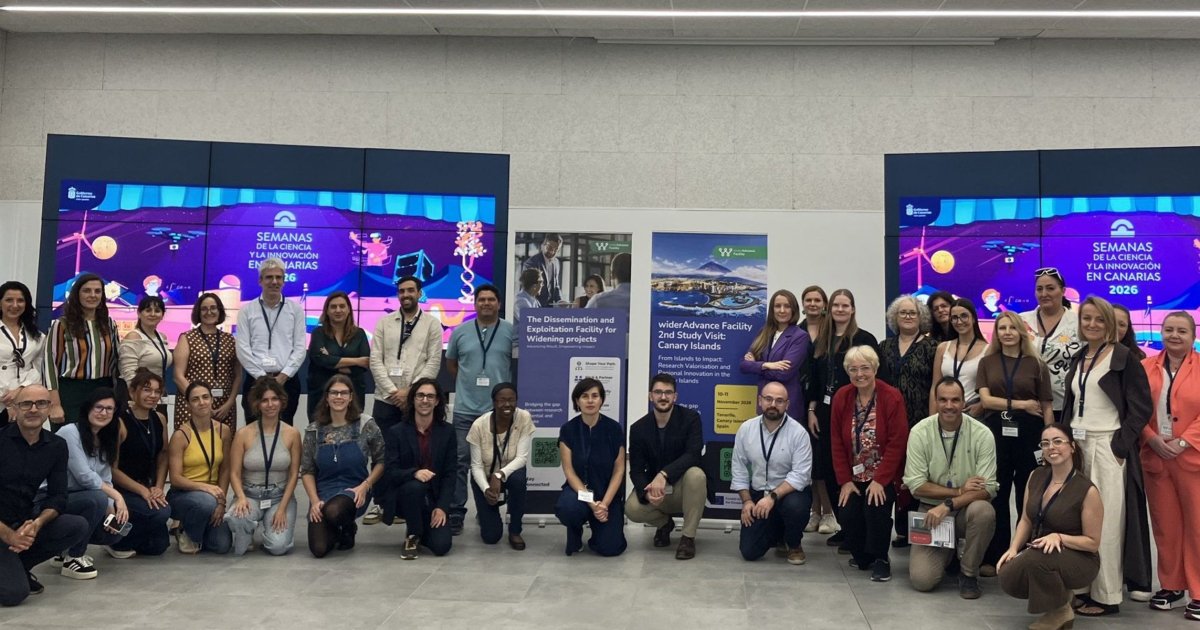
A study visit and matchmaking event held between 10 and 12 November in Tenerife has boosted the international profile of the Canary Islands’ scientific and technological capabilities. This initiative was organised by the Government of the Canary Islands’ Ministry of Universities, Science and Innovation and Culture, through the Canary Agency for Research, Innovation and Information Society (ACIISI).
Part of the official programme for the Canary Science and Innovation Weeks 2026 (SCIC26), the event is linked to the European Wider Advance Facility project, funded by the Horizon Europe programme. It aims to facilitate the dissemination and exploitation of research results while connecting regional researchers with international collaboration opportunities.
Attendees explored key infrastructures, specialised laboratories, and innovative projects from various scientific and technological centres in Tenerife, fostering exchange and synergy among participants.
Institutional Opening and Strategic Infrastructure Tour
The event started with a welcome from Gonzalo de la Torre de Juan, ACIISI representative, alongside Antonio Aparicio Juan, Vice-Rector for Research and Transfer at the University of La Laguna (ULL), Katarzyna Walczyk-Matuszyk from the Institute of Fundamental Technological Research PAN, and Tomás Martín Ruiz, director of IPNA-CSIC.
Following an initial networking session, the group toured facilities at IPNA-CSIC, including the Air Quality and Biological Activities services, as well as laboratories for Medicinal Chemistry, Natural Products Library, and Agrobiology.
The agenda continued at ULL’s General Research Support Service (SEGAI), where attendees learned about advanced mass spectrometry and electron microscopy. The day concluded with a visit to the Technological Institute of Renewable Energies (ITER), where renewable energy installations, a wind farm, and supercomputing labs were showcased.
European Funding Opportunities and Cutting-Edge Innovation
On the second day, the focus was on exploring avenues for European cooperation and funding to enhance the Canary Islands’ international engagement. Anselmo Sosa Méndez from the Canary Institute of Astrophysics (IAC) and Héctor Martínez Hernández from the Technological Institute of the Canary Islands (ITC) provided insights on opportunities within the Widening calls, followed by a Q&A session.
The participants then delved into high-specialisation sectors in Tenerife, touring Arquimea, which offered insights into quantum computing, robotics, neuroscience, and biotechnology, as well as funding mechanisms for their R&D projects.
At IACTEC, attendees examined facilities focused on scientific and space instrumentation, including clean rooms for optical instrument assembly and satellite design. The tour concluded at the Canary Islands University Hospital (HUC), where researcher Esteban Porrini presented an innovative low-cost method for measuring kidney function using microdroplets on blotting paper, a less invasive option for monitoring renal patients.


