


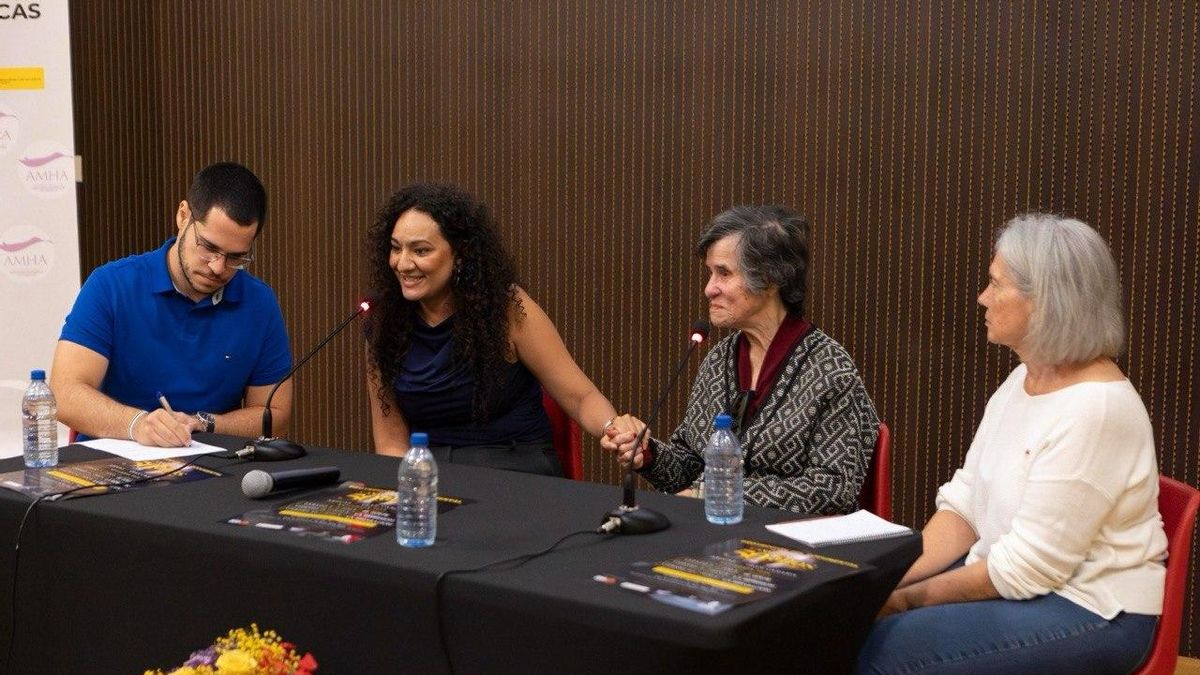
The third episode of the documentary series “Canarias: 50 Years After the Darkness,” titled “La Reparación”, aired in Arucas on Friday, 20 November. The series, produced by Clan de Medios, highlights the ongoing struggle of victims seeking to uncover the fate of their missing loved ones from the Franco era.
The successful screenings were organised by the Historical Memory Association of Arucas, led by Pino Sosa. Each screening included a discussion panel that attracted considerable participation. Arucas’ Councillor for Culture, Carlos González, emphasised the importance of such events for reflection on historical memory.
The latest episode focuses on personal stories, including Pino Sosa’s, as well as accounts from Félix González of La Palma’s Historical Memory Association, Paco González from the Vegueta Common Grave Family Association, and Pepe Valencia of the Agaete Historical Memory Association. During the discussion, they stressed the need for society to understand why these individuals continue to seek reparations, with thousands still missing 51 years after Franco’s death. Many disappeared individuals are believed to be buried in locations like the pits of Arucas, Tenoya, and the Sima de Jinámar.
An emotional Pino Sosa urged for inclusion of these narratives in school textbooks and expressed her determination to find victims of Franco’s repression, including her father, José Sosa Déniz. “Let us not forget,” she said, as she continues her pursuit of justice for those affected by the regime.
Eduardo Hernández, a legal expert and volunteer for the association, spoke on transitional justice’s importance, aiming to achieve truth and reparations, a sentiment echoed by those featured in the episode.
Journalist Jennifer Jiménez also highlighted the need to erase Francoist remnants from public spaces, stating that monuments to the dictator are an affront to the victims. Inma Suárez discussed the association’s educational initiatives, allowing students to engage with testimonies like Pino Sosa’s.
Among the audience was Ramón Díaz, a retired professor from the University of Las Palmas, who called for further dissemination of historical memory, particularly as recent educational laws have started to address democratic memory, despite potential changes by incoming political forces.
Others in attendance voiced a strong interest in promoting awareness of this history, noting that fear has silenced many for years, with some learning about these events over 50 years after Franco’s death. Hernández concluded by quoting magistrate Joaquim Bosch, underscoring that democracy requires respect for political pluralism, separation of powers, and effective protection of fundamental rights.


